Plein Air Primer
by Steve Whitney
Painting en plein air—that is, outdoors, on location—is a delightful way to sharpen your painting skills, enjoy the outdoors, and hang out with friends. Just as working from a live model improves your drawing skills, so painting on location helps you strengthen your compositions and to see both values and colors more clearly.
These benefits accrue regardless of whether you ever paint landscapes in the studio and cannot be entirely replaced by working from either models or still-life setups. For landscape painters, of course, painting from life will lend authenticity to your work regardless of how skilled you otherwise may be.
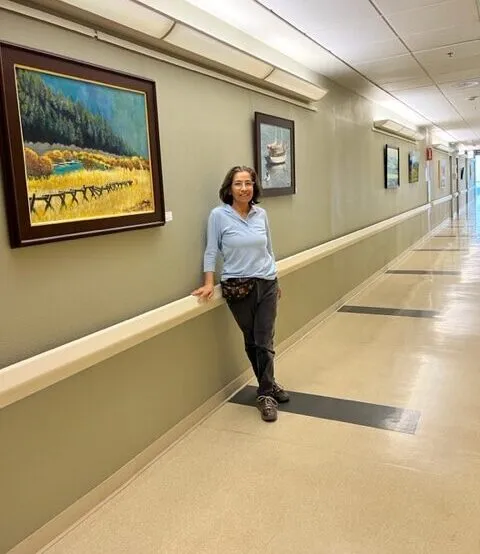
Public Art Manager, Laura Grover
Yes, it’s true: painting outdoors on location is challenging, but in that challenge lies its value to all painters. Nature offers far more information in any given scene than you can possibly include in a painting. That means you have to learn how to pick and choose and to simplify the complexity before you. That’s a skill you will find useful regardless of the type of work you do.
Shifting sunlight presents another useful challenge. Because the scene before you changes minute by minute, the first step in any plein-air painting, regardless of the medium you choose, should be to quickly capture the pattern of light and shadow. Once you have established that pattern, you also have established your basic composition and from there can complete the painting without worrying about the movement of the sun or the interference of passing clouds. Learning to quickly assess the possibilities of a scene and block it in encourages the use of large shapes and simple patterns. This, again, is a skill that translates seamlessly to studio painting.
Many artists avoid plein-air painting because they fear feeling embarrassed in front of their peers or onlookers. They shouldn’t worry. Onlookers are almost always amazed and delighted, and your peers share all your challenges and frustrations.
Painting en plein air—that is, outdoors, on location—is a delightful way to sharpen your painting skills, enjoy the outdoors, and hang out with friends. Just as working from a live model improves your drawing skills, so painting on location helps you strengthen your compositions and to see both values and colors more clearly. These benefits accrue regardless of whether you ever paint landscapes in the studio and cannot be entirely replaced by working from either models or still-life setups. For landscape painters, of course, painting from life will lend authenticity to your work regardless of how skilled you otherwise may be.
EAFA’s Plein Air FAQs
MEETING
Most people show up at “about” 9 a.m. at the location listed on the schedule. If you are a newcomer, generally you will see easels popping up near the parking area, but if we are at a distance from the cars the schedule will include directions to the place where we are painting. On some sites, we are spread out over a large area and gather at lunch. A coordinator is usually somewhere on the site by 9:00, but there is no formal meeting.
LUNCH
We meet for lunch at 12:00 p.m., near the parking area unless otherwise indicated on the schedule. We share and discuss the morning’s work (if you so choose) during the lunch break, but there is no formal critique. Some people continue to paint after lunch.
DIRECTIONS
The directions to the locations are on the schedule and include an address whenever possible to use in an online maps/directions website. There will be specific locations as to where we will be painting if we are at a large site. If a parking pass is required (Discover Pass, National parks/forest pass), that, too, is indicated on the schedule.
SUPPLIES
If you are just beginning Plein Air painting, there are many suggestions and lists online to guide you on what you might want to bring. We have an excellent Plein Air Primer written by member Steve Whitney. Or you can just come the first time with a minimum of what you need and get ideas from those who have been painting outside for years. Everyone has their own way of setting up, so it’s good to see many ideas. Be prepared for all conditions. Some use an artist’s umbrella for sunny areas, and you should expect wind, which can tip over an easel in a minute.
POLICIES
It is very important to be careful to "leave no trace". No dumping of any materials, including water-based paints and watercolors(!) as well as oils, since the pigments in all paints are toxic. No rinsing equipment off in rivers or lakes or dumping wash water; and take all rags and trash with you.
MEMBERSHIP
Membership in EAFA is not required to join us, but keep in mind that our group benefits a great deal by being part of the EAFA organization. Go to our membership page to join.
CONTACT
Write us here for questions and to get on the email list for any changes. Plein Air Coordinators are Sharon Blickenstaff, Judy Gilbert, Anna Lee and Steve Momii.